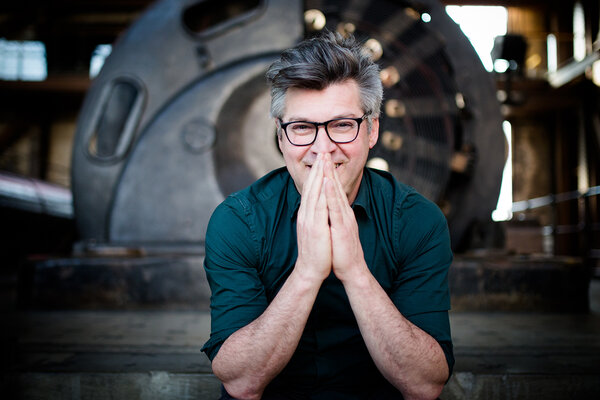
Many of the artistic works in this edition engage with questions surrounding democracy and community. They vividly illustrate how fragile democratic structures can be, but also the potential of collective action. The Belgian sociologist, art theorist and author Pascal Gielen has long explored the relationship between art, politics and society. In his essay, he describes democracy not as a fixed, unified system, but as a dynamic interplay of different practices. Gielen attributes a particular role to theatre – provided it no longer sees itself solely as a space for the free arts, but as a space of the common, as a «commonist» practice.
Essay by Pascal Gielen
Mistake
Something peculiar is happening today in artistic and academic circles. Each time a new illiberal wave breaks ashore, each time Orban dismantles the judiciary in Hungary, each time Modi methodically cuts minorities from the fabric of Indian democracy, each time Trump re-enters the White House with the bravado of someone who does not break the rules but simply throws them away, a strange convergence overcomes the intellectuals: despair and longing that arrive together, inseparably. Political thinkers give voice to a widely shared sentiment: return to liberal democracy. Defend it. Repair it. It is the best we have. Francis Fukuyama once announced the end of history, the triumph of liberal democracy as the definitive form of government. That announcement sounds today like an echo from a drowned world. Yet, strangely enough, its failure did not produce the opposite effect.
Liberal democracy, however, carries deep within its own architecture the seed of what it now claims to resist. Between liberalism and democracy there exists a fundamental paradox, an incompatibility that rational deliberation alone cannot resolve. Democracy requires a demos, a people that governs itself as a community with shared substance. Liberalism distrusts precisely that collective subject and installs in its place the sovereign individual and her rights. The tension between the two is not resolved within liberal democracy but frozen, and what is frozen can also crack or melt beneath our feet. What we have witnessed over the past four decades is how that fracture deepens from within: freedom redefined as individual market autonomy, public spaces and institutions absorbed into the logic of performance indicators, and the social bonds that make democracy livable systematically thinned. The result is a social atomization so thorough that it generates longing for precisely what liberal democracy claimed to want to prevent: the strong hand, the protective leader, including a clear enemy. The illiberal regime is not the opposite of liberal democracy. It is its dark heir. What illiberal regimes do is make explicit, through law and coercion and screaming rhetoric, what liberal democracy had already achieved more quietly: the hollowing out of democracy.
Whoever defends liberal democracy defends at the same time a particular model of formation, of knowledge and civilization. That model has a name: the liberal arts. The kinship is no accident. It is etymologically grounded. The Latin liber means free, and the first documented appearance of the word liberal in its modern sense, in 1375, describes precisely the liberal arts as the formation befitting a freeborn man. The artes liberales, the skills of the free citizen in Greek and Roman antiquity: grammar, rhetoric and logic - the instruments with which a man participated in public life. Not in any public life. In the life of one who was already free, who owned property, who already belonged to the political community. Slaves and women had a different education. They had the artes mechanicae, the knowledge of the useful, the knowledge of the hand.
The liberal arts were never a universal project. They are the project of a particular freedom: the freedom that presents itself as universal but is fundamentally exclusive. And that line runs directly through to the contemporary fine arts, which invoke the nineteenth-century bourgeois culture as their spiritual home without much critical reflection. For what the bourgeois revolutions produced politically, they also produced aesthetically: a figure we still know and admire, namely the singular artist. The autonomous creator. And sometimes, even still, the genius.
As is well known, that genius was unthinkable in the Middle Ages. Paintings and sculptures were typically made collectively in workshops and guilds, anonymously, in service of a commission greater than the maker. The rupture came with the Renaissance, and it was not purely artistic. It was ideological. In Northern Europe, figures such as Jan van Eyck and Albrecht Durer placed their names and monograms prominently on their work, sometimes as emphatic visual declarations rather than modest labels. The Renaissance transformed the status of the artist from skilled craftsman to creative ego. And with the rise of the commercial art market in the nineteenth century, signing a painting became almost self-evident: the signature transformed from optional ornament to expected authentication, but also to a brand with a price tag.
That signature is not neutral. It is a political act in miniature. It declares: this work is mine, it flows from my inner life, it bears my name and my reputation, and its value is inseparably bound to my ego as creating subject. It thereby declares itself independent of the social context in which it came to be. The artistic genius and the liberal citizen are children of the same project, and neither is extinct. The self-made artist is the self-made man. The signature on the canvas is the legal claim beneath the property deed.
The question then is whether theatre confirms that line or breaks it. Whether it places the singular artist on the stage as the last genius displaying his soul to a paying audience, or whether it dares to imagine something else: a different distribution of creative capacity, a different configuration of who makes and who watches, a different logic of being together in the same room. A theatre that dares to go beyond the liberal ego.
Liberal versus Social Democracy
What many of us remember from growing up in continental Europe is not liberal democracy. It is something else, something that deserves a different name and had a different architecture. Near-free education, a public broadcaster that did not have to compete to survive, subsidized theatre and arts that did not have to prove their market relevance, a social safety net that deserved its name because it was structural, not dependent on goodwill or economic conditions. Healthcare accessible without a credit card. Not a perfect society. Not a society without tensions, injustices and shortcomings. But a society carried by a fundamental insight: that freedom only becomes real when it is equally distributed, that equality is not a formal abstraction but a material precondition, and that solidarity is not the residue of individual success but the ground on which freedom and equality can flourish at all. We called that social democracy. Not the liberal democracy of Locke, of the invisible hand and the American Dream. Something else. Something continental, something rooted in the three values of the French Revolution, and taking all three equally seriously.
But before we can arrive at social democracy, and at the question of what its restoration requires, we must understand how we drifted so far from it. For the illiberal regimes we see emerging everywhere today did not come from nowhere. They were prepared. And the one who prepared them was none other than liberal democracy itself, from which a repressive liberal model was born in the late 1970s.
I prefer ‘repressive’ to the word ‘neo’-liberalism because what unfolded over the past forty years is not a new freedom but a contraction of it. A politics that embraces individual and market, preaches deregulation and elevates creative entrepreneurship as an ideal, but which simultaneously and paradoxically ratchets up control over all that freedom. To proclaim freedom and manage it at the same time: that is the specific stranglehold of repressive liberalism. It promises freedom while suffocating it.
The result is a double movement that presses on a person from two sides at once. On the one hand, one is pushed into a permanent rat race: one must entrepreneurialize, perform, surpass oneself, stay ahead of competitors. On the other hand, one is continuously monitored for output, impact and return. This resembles nothing so much as the Hobbesian state of nature in a new costume: the war of all against all, organized through market mechanisms and administered through spreadsheets and algorithms. Hobbes knew that in that condition people sooner or later desire what he called the Leviathan: the great protector, the sovereign who imposes order on chaos. The Leviathan promises rest in exchange for obedience. And he is not imposed. He is desired. In short: the illiberal regime is the new Leviathan of the exhausted homo economicus.
Repressive liberalism prepared the ground for illiberalism. Mark Rutte pursued years of market liberalization and cuts to culture, healthcare and education in the Netherlands. Geert Wilders and his far right party were the electoral answer. Matteo Renzi dismantled worker protections and presented this as progressive realism. Fascist Giorgia Meloni picked up the pieces. Bill Clinton and Barack Obama dismantled the social-democratic ambitions of the Democratic Party in favour of what Nancy Fraser called progressive neoliberalism: culturally progressive, economically right. Donald Trump understood what the Democrats did not: that the abandoned casualties of that progress – the red necks - were angrier than they had imagined.
To understand what role theatre can play here, a more precise democratic vocabulary is needed. Democracy is not a singular entity. It is a plural given, a coexistence of at least three historically developed but today simultaneous practices and logics that ceaselessly contest one another.
The first is representative democracy. Power is determined here by quantity: whoever wins the most votes governs. Its cultural policy is unmistakably bourgeois: national museums are built, state theatres erected, theatre mandated to spread an official standard language. ‘General Civilized Dutch’ in Flanders and the Netherlands; Royal English in the U.K. and Literary Russian in Russia. Each qualifying adjective that culture received in this formation - civilized, royal, literary - reveals that language and cultural policy here constitute part of a civilizing offensive. Culture flows from above downwards. The theatre that belongs to it is the great bourgeois repertoire theatre: the state company, the national opera, the canonized repertoire.
The second form of democracy unfolds in the 1960s and 1970s as a reaction to precisely that vertical logic. Deliberative democracy shifts the weight from quantity to quality: not the number of votes but their quality matters, the well-considered argument. The public sphere becomes a space of rational deliberation. The theatre that belongs to it is the theatre collective, community theatre and multiculural theatre: artists enter the community, listen, process, give voice to what was previously unheard. But here too there is a structural limit. Deliberative democracy systematically favours whoever commands its register: whoever has education, rhetorical skill, the correct language and cultural capital. In short, it favours the white middle class.
That deliberative space is today under severe pressure. Not only from illiberal regimes, but already earlier from repressive liberalism itself. The privatization and over-regulation of community centers, cultural venues, trade unions and youth organizations has systematically hollowed out civil space. Liberal rhetoric has pushed culture from education and vital provision towards the leisure industry. Illiberal regimes then take the final step: they not only drain the deliberative culture but abolish it. Museums and theatres are nationalized or simply shut. The judiciary is captured, the free press suffocated, academic and artistic freedom curtailed.
The reaction that follows is the third democratic form: agonistic democracy. Agonism does not proceed from consensus but from conflict as a constitutive given. It transforms antagonism, the logic of friend and enemy, into agonism: the logic of adversaries who share a common space but contest its meaning. Conflict is not resolved but channeled, converted into dissensus: a rearrangement of the sensible, a new distribution of who speaks, who is seen, who counts.
Where deliberative democracy trusted the quality of the argument, agonistic democracy trusts affect and corporeality. It operates through performance rather than debate. And it is no coincidence that the rise of illiberal regimes coincides with an aesthetic turn in politics. The contemporary politician has become a performer: someone whose politics is not primarily a matter of rational arguments and policy documents, but of posture, volume, rhythm and the raw energy of a crowd that recognizes itself in a voice that screams what they feel. Trump, Orban, Meloni, Wilders all operate in the same register. But the early Gay Prides of the 1980s were not debate evenings either. They were performances: bodies in public space, visibility as political act. Black Lives Matter was as much an aesthetic as a political phenomenon. Companies such as Rimini Protokoll or collectives working in the tradition of Augusto Boal’s Theatre of the Oppressed produce not a representation of reality but an intervention in it. Agonistic politics belongs to both right and left.
None of the three democracies is therefore adequate in itself. Representative democracy counts votes but reduces citizenship to a periodic act. Deliberative democracy weighs arguments but favours whoever speaks the right language. Agonistic democracy gives voice to the body but can, without institutional channeling, just as readily fuel populist violence as democratic activism. Trump is an agonistic performer. But so was Martin Luther King. With the crucial distinction that the first holds a position of power, while the other spoke for the dispossessed. It is the moral and political substance of the agonism that makes the difference, not the form itself.
Social democracy is the political outcome of a genuine equilibrium between the three democratic forms: a representative structure that counts and weighs; a deliberative culture that debates and recognizes; and an agonistic practice that gives voice to all without a voice while ceaselessly asking for whom the consensus exists and for whom it does not. They must complement and challenge one another, and in that tension restore what liberal democracy has allowed to lapse: equality as the structural precondition of freedom, and solidarity as the ground on which both can stand.
Theatre can play a constitutive role in this field of forces. But for that, it would do well to exchange its liberal arts model for another. I call it, for convenience, a ‘commonist model’.
Commonist Theatre
You read that correctly. With an ‘o’, not a ‘u’. Commonism differs profoundly from communism and stands equally far from the prevailing neoliberalism. Despite being ideologically miles apart, communism and neoliberalism share something central: both regard economics as the base of society. The difference with commonism is that it locates the base not in economics but in culture. Not in contracts and competition but in social relations and mutual trust. It uses words and ideas to imagine and try out new economies, political and social models. And commoners know energy comes not from trade and labour, but from collective life, collaboration and – of course - celebration.
According to the rules of the commons, people come together not because they share the same identity or class, but because they share the same needs: drinkable water, affordable energy, decent education, an affordable rehearsal space, a healthy working and living environment, or the right forms to express themselves and lead a meaningful life. Commoners respond to what a government neglects and where a market sees no profit, but where a genuine need exists. They gather around shared vulnerabilities. They do not look to an authoritarian Leviathan to solve it for them but look to each other for a self-devised way out. Looking to each other means acknowledging mutual dependence. It also means the necessity of finding solutions with people one does not know, sometimes does not like, with whom one does not share ideological or religious conviction, but with whom one must nevertheless, in that dissensus, reach a consensus about what matters.
Could theatre contribute something here? What particular quality does the theatrical space possess that makes it suitable for constituting social democracy? The media sphere and other public spheres can certainly contribute, but theatre has something that distinguishes it: the physical proximity of bodies in a shared space, the immediacy of presence, the shared vulnerability of people who withdraw for a moment from their private life and public mask to share something that belongs to no one and to everyone at once.
Even a state theatre or a commercial musical always generates a surplus that is neither public nor private. It is quasi-public. It belongs to that third domain between market logic and state power that constitutes civil society but is rarely named as such. The difficult-to-measure and difficult-to-grasp atmosphere that mingles among the audience and the theatre-makers. Whoever enters a theatre does so on the basis of a shared interest, what might be called a common third. That shared interest makes it possible for the intimacy of the private sphere to touch the anonymity of the public sphere. Urban intimacy: one sits beside people one does not know and will perhaps never know, yet with whom one feels briefly connected in something greater than one’s own life. That is not sentimental. It is political.
Citizens are not moved into action by rational arguments alone but by the impression that images, sounds, manners of speaking and moving leave on them. It is the atmosphere, the ambiance, the collective body in the space that generates the civic courage that precedes political action. The theatre has historically been the place where that courage was charged. It is no coincidence that the people of Belgium ran from the Munt Theatre in 1830 to proclaim Belgian independence, not after a plenary session or a debate evening. They had been to an opera. It was the atmosphere of collective togetherness, of the shared tremor in the dark, that moved them. Theatre is the glue of civic life because it physically brings together people who share the same need, even if they do not yet know it when they take their seats.
And it is precisely this architecture of the quasi-public sphere that gives theatre the possibility of doing what neither market nor state can, and what media, social or mainstream, find difficult to achieve because they do not create the necessary intimacy for it: theatre can and dares to name the shared vulnerabilities that give social democracy its ground. But only on condition that it abandons the liberal arts idea and evolves towards a commonist model. I have provisionally detected three aesthetics that play a constitutive role in this, recognizable in urban contexts across Europe and beyond.
Beautiful Thinking
The first aesthetic is what the philosopher Alexander Baumgarten called beautiful thinking, ‘das schöne Denken’: a way of knowing that does not proceed via the concept but through sensation, association and the not-yet-said. It is a mode of knowledge that seeks out the edges of the sayable, that sensitizes us to what has not yet found a name, that makes space for the unexpected. The central question it poses is that of the unrepresented: who are the people absent from the official narrative of the community, whose presence is real but whose voice is absent from the public order? Democratic art, in this sense, is art that interrogates that distribution, that makes the invisible visible, that gives sound to what has not been heard.
Theatre that practices beautiful thinking enters the lives of those who are present in the city but systematically absent from its public imagination. The overlooked neighbour who has carried a burden for decades but never shared it with anyone. The worker who maintains the fabric of the city every day but cannot appear in any image of it. The newly arrived family who has placed its hopes on a street that the official city has never bothered to portray. Their stories, gathered through patient listening and months of sustained presence in the streets and squares where they live, become the material of a theatrical composition that offers the city a portrait of itself it would never have dared to make on its own.
When such a work is staged, not only as representation of the overlooked but as their own appearance as subjects of their own stories, something shifts in the room. The people who do not count, who are not represented in the official imagination of the community, here count very emphatically, for once. Not because they are to be pitied, but because each of them has a story that matters. Beautiful thinking makes visible those who are not seen. That is a political project of the most fundamental kind. One can find this practice at work in many European cities, in the community-based theatre of companies such as Theatre HORA in Zurich, or in the documentary performance traditions that have flourished in Berlin, Hamburg and beyond.
Situational Art
The second commoning aesthetic is what I call situational in-situ art. All knowledge is situated knowledge: there is no Archimedean point outside the world from which one can neutrally observe reality. Whoever wants to understand something must be present on site, must live through the situation with their own body, must take the local temperature with a sensibility that is not imposed from outside but found from within. The situational artist does not begin with a concept but with a presence.
Consider the hyperdiversity districts that mark most European cities: the multilingual neighbourhood where dozens of nationalities share a handful of square kilometers, where young families live alongside seniors who have watched the neighbourhood slowly change, where people from across the world build a common home in streets that official urban imagination rarely portrays in a positive light. Think of the Langstrassequartier in Zurich, the Bijlmer in Amsterdam, Wedding in Berlin. These are places that media and policy have reduced to a problem for decades: places of poverty, of the incomprehensible other. And yet they are often among the most alive and beautiful districts in their cities, places where the world coexists with relative harmony, where the texture of daily life carries a richness that no representation has found adequate means to convey.
Situational in-situ art does not import a vision from elsewhere. It listens. It stays. It transforms what is already there, the virtuosity and beauty of a daily life that is never put on screen because it does not meet the standards of the representable city, into an aesthetic experience that displaces something: not only who stands on the stage but also who counts as audience, who has the right to be heard. Like a seismologist, the situational artist registers what trembles beneath the surface and lifts it into an aesthetic imagination that returns the place to itself. No representation of the other through an outside gaze. But a listening, a being-present, an intervening from the vulnerability of one who also belongs to the place.
Depth Aesthetics
The third commoning aesthetic I call depth aesthetics. It goes further than the horizontal contemporaneity of the two preceding forms. It asks not only: who is absent from the current narrative? And not only: what is alive in this concrete place at this concrete moment? It asks also: what did our ancestors experience, what trauma is stored in our collective body, what knowledge lies buried in the sedimentary layers of our shared history?
Depth aesthetics connects the present to the past not through the rhetoric of national memory but through the universal vulnerability that every community shares with every other: the vulnerability of whoever is forgotten, of whoever is taken away, of whoever looks and looks away, of whoever is born later into a world shaped by what was done and silenced before them. Depth aesthetics is not nostalgia and not grief-work in the therapeutic sense. It is a way of feeling how the past is present in the present, how trauma, whether from loss through Covid-19 or through war and violence, does not end with the generation that lived through it but seeps through the bodies of those who come after.
The best examples of this aesthetic work like detective sociology: digging through archives and court records, standing before closed doors, following the traces of what a community has pushed away with all its force in order to exist, but which continues to haunt it precisely because it has been so thoroughly repressed. What such work uncovers is not the official history of a city or nation but its repressed soul: the deported and the forgotten, the neighbours who drew their curtains, the politicians who granted collaborators amnesty for electoral gain. A chocking experience lives on in today’s reflexes, in the double tongue of a city or nation that colours its policies on the basis of traumas it has never dared to name.
But depth aesthetics is neither indictment nor therapy. It does something subtler and more courageous: it lets the audience feel the repressed, creeping, through the aesthetic quality of the work itself, through the way the past is placed alongside the present until the connection becomes visible without anyone needing to point a finger. And precisely in that lies its democratic power. For a society that denies its shared vulnerabilities, that refuses to name its shared traumas, is a society that sooner or later falls back on the familiar mechanisms: pointing to the enemy, blaming the other, calling for the leader who promises order in the chaos. Depth aesthetics is the antidote: it does not demand reconciliation in the naive sense, but the courage to acknowledge what really happened and how it continues to operate in what is now at hand.
Commoning Aesthetics and Social Democracy
Three aesthetics, three ways in which theatre creates the conditions for a democracy that is not liberal but social. What connects them is a political grammar: the grammar of commoning. They all pose the question of what brings people together, not despite their differences but through their shared needs, and they acknowledge mutual dependence as the ground of democracy.
This theatre already exists, in Zurich and Geneva, in Hamburg and Kyiv, in Manaus and Beijing, in cities across the world where artistic collectives have the courage to take the question of community seriously. I think of She She Pop and Rimini Protokoll in Berlin, of Theatre HORA in Zurich, of companies across Europe and beyond working in the tradition of Augusto Boal. All of them, in their own way, constitute an answer to the question of what theatre can do when it goes beyond the liberal arts line and the artistic ego.
The social democracy that many of us remember from growing up was built on the insight that freedom only becomes real when it is equally distributed, that solidarity is the ground on which freedom and equality flourish. Theatre that practices commoning aesthetics reminds us of that insight, not through a political manifesto but through the experience of being together in a room, beside people we do not know, before stories that are not only recognizable to us, the white middle class. Theatre as quasi-public space that brings together people of very diverse background. Theatre as beautiful thinking that makes the invisible visible. Theatre as situational intervention that returns the neighbourhood to itself. Theatre as depth aesthetics that names the repressed and makes it common.
That is the democratic potential of theatre after liberal democracy. And it feels rather urgent now, as darkness advances both nationally and geopolitically and the temptation grows to retreat into the private sphere, to spin endlessly in one’s own anxiety. Theatre is by nature the opposite of that retreat. It is the art that physically draws you from your home, that places you in the dark beside people you do not know, and in that dark lights something: not the certainty that things will be all right, but the memory that we have been here before, that people before us, in precisely such times, found the courage to be together and to dream together of what could be otherwise. The curtain that rises each evening is a small act of revolt against the thought that the world is as it is and cannot be otherwise. That the darkness is the last word. It never is.
Pascal Gielen
Pascal Gielen is Full Professor of Sociology of Culture and Politics at the University of Antwerp, where he directs the Culture Commons Quest Office (CCQO/ARIA). He edits the Antennae / Arts in Society book series at Valiz. Recent books include «Trust: Building on the Cultural Commons» (2024) and «In the Absence of Bombs» (2026).